Book a Consultation
 LOGIN
September 2026
Economic and market overview
- Global: Global long-end yields continued to move higher in September, as expectations increased regarding further central bank hikes amid ongoing elevated energy prices and inflation concerns.
- Oil prices rose during September, as conflict in the Middle East remained ongoing, however the spread between WTI and Brent widened. Brent gained +14.4% to US$103.53/bbl, while WTI advanced +5.4% to US$90.42/bbl. WTI saw declines in the back half of the month amid growing concerns regarding a potential US restriction on diesel exports.
- Gold spot fell -6.3% in September, to US$4157.41/oz amid a stronger USD and higher US Treasury yields.
- The MSCI World Index fell -1.3% in September, amid mixed regional performance.
- The August global manufacturing PMI increased to 52.3, supported by the AI infrastructure buildout. The global services PMI advanced to 53.7, driven by strength in Spain, the US and Italy.
- Despite headwinds from the Middle East, global export volumes have shown resilience, up 5% from conflict lows as June AI exports grew to US$1.5tn at an annual rate, more than doubling in the past year.
- Global headline inflation ticked lower to +2.6% YoY in July, however, remains ~0.5ppt above pre-conflict levels.
- US: The Fed delivered a unanimous 25bp rate hike in September, with a median "dot" showing one further 25bp hike by year-end. The market has priced 29.5bps of further hikes from the Fed by the end of 2026.
- US equities were mixed in September, with the Nasdaq advancing +1.9%, while the S&P500 and Dow both saw declines, down -0.5% and -4.3% respectively.
- The DXY appreciated +2.0% during the month amid rising Treasury yields.
- August employment data was stronger than expected, with a +162k increase in payroll employment, higher than expectations for +55k. The unemployment rate remained steady at 4.1% in line with expectations.
- Core CPI rose +0.3% MoM in August, stronger than consensus expectations for +0.2% MoM. On an annualised basis, core CPI rose +2.4% YoY in August, in line with expectations.
- Conference Board consumer confidence fell in September to 81.9, the lowest level since 2014 and softer than consensus 89.0.
- Core PCE inflation rose +0.2% MoM in August, softer than expectations for +0.3% MoM. With revisions, core PCE increased +3.0% YoY in August, softer than consensus +3.3% YoY.
- The preliminary September manufacturing PMI increased sharply to 57.0 from 53.2 prior and above expectations for 53.7. The services PMI rose to 58.7 from 56.8 prior and stronger than consensus 55.8.
- August housing starts fell for a second month to 1275k, driven by multifamily starts, which fell to 357k.
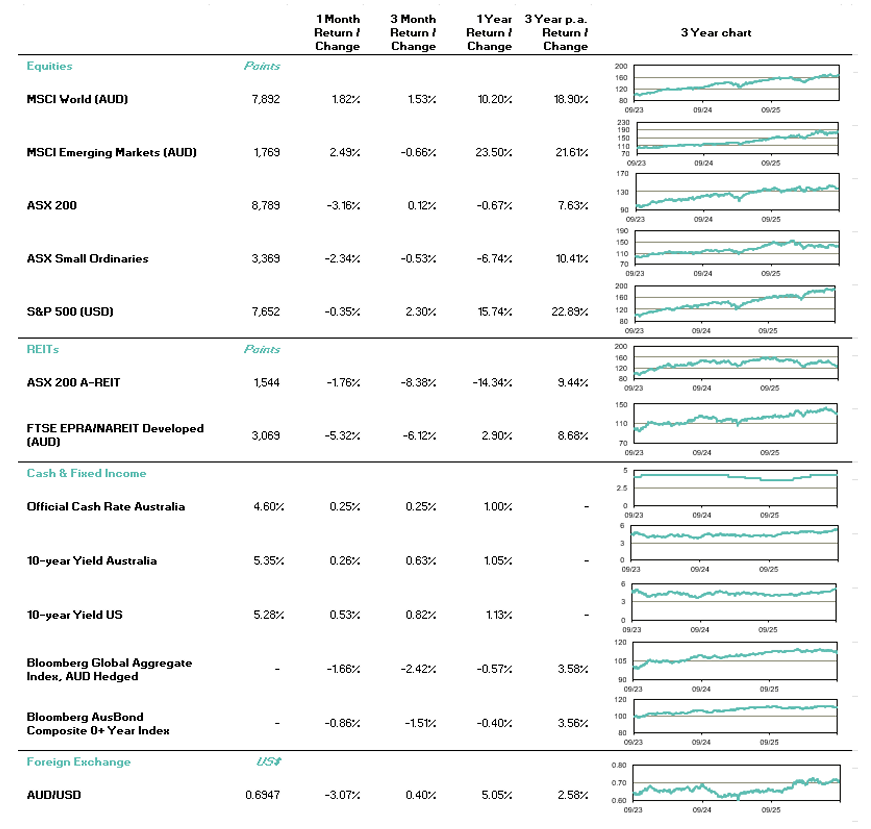
- Australia: The RBA delivered a unanimous 25bp rate rise, bringing the cash rate to a 15-year high of 4.60%, with the Board citing persistently elevated inflation and materialising upside risks. The market has priced 10.4bps of further rate hikes from the RBA by year-end.
- The ASX200 fell -3.2% in September, with tech stocks leading declines, down -10.8%. Healthcare was the only sector to advance, up +3.4%.
- The AUD depreciated -3.1% against the USD in September to close at 0.6947 USD.
- August household spending was flat, lower than consensus expectations for +0.4% MoM, driven by an increase in fuel prices which prompted a decline in recreation and culture spending. Total household spending eased from 7.0% YoY to 6.8% YoY.
- The unemployment rate ticked higher to 4.6% in August, due to an increase in the participation rate to 67.1% (vs consensus 66.9%). Employment growth of +39.5k jobs was nearly double expectations for +20k jobs, driven by an increase in part-time employment.
- August headline CPI printed at +0.4% MoM, softer than consensus +0.5% MoM, driven by softer health, clothing and footwear. Headline CPI rose +4.0% YoY in August, softer than expectations for +4.1% YoY.
- Q2 GDP expanded +2.1% YoY, stronger than expectations for +1.8% YoY.
- New Zealand: The RBNZ delivered a widely expected 25bp hike, bringing the OCR rate to 2.75%. The accompanying statement signalled a more dovish turn, with a softening in language regarding potential future OCR increases.
- Europe: The ECB raised interest rates by 25bps as widely expected. The market has priced 29.6bps of further rate hikes from the ECB by year-end. The Bank of England kept interest rates on hold in September as expected. The market has priced 37.3bps of rate hikes from the BoE by the end of 2026.
- European equities broadly declined in September, with the STOXX600 down -2.5% on the month. The regional bourses in the UK, Germany and France all saw declines on the month.
- September preliminary Eurozone PMIs saw the manufacturing PMI remain stable at 52.7, while the services PMI increased to 53.0 from 51.6 prior.
- August preliminary CPI rose +0.4% MoM, in line with expectations, up +3.3% YoY on an annualised basis.
- GDP expanded +0.6% QoQ in Q2, stronger than expectations for +0.4% QoQ.
- July retail sales declined -0.6% MoM, softer than consensus expectations for a +0.2% MoM increase.
- China: The PBoC cut the PSL rate by 25bp to 1.5% at the end of September, and raised the quota for relending loans to support tech, agriculture, SMEs and private companies.
- September preliminary manufacturing PMI entered expansion territory, increasing to 50.1. The non-manufacturing PMI also entered expansionary territory in September, at 50.2.
- Industrial production increased to +5.2% YoY in August, above expectations for +4.8% YoY and up from +4.5% YoY prior.
- August retail sales were softer than expected, at +0.4% YoY vs consensus +0.8% YoY.
- August CPI rose to +0.8% YoY, in line with expectations and up from +0.5% YoY. Core CPI excluding food and energy remained steady at +1.0% YoY.
- PPI was stronger than expected in August, at +3.8% YoY vs expectations for +3.6% YoY.
Australian dollar
- Following strong performance in August, the AUDUSD pair traded -3.1% lower in September. The pair traded a 295-pip range, touching a high of 0.7238 on 9 September and a low of 0.6943 on 30 September, closing the month at 0.6947.
- The DXY strengthened +2.0% on the month as US 10yr Treasury yields rose above 5% and geopolitical tensions remained ongoing.
- The Fed increased interest rates by 25bps, with the market pricing 29.5bps of further rate hikes by year-end.
- Australia Q2 GDP rose +0.4% QoQ, above consensus expectations for +0.3% QoQ and +2.1% YoY, above expectations of +1.8% YoY.
- August household spending was flat, lower than consensus +0.4% MoM, rising +6.8% YoY below expectations of +7.1% YoY.
- August employment rose +39.5k jobs, stronger than expectations for +20.0k. However, the unemployment rate ticked higher to 4.6% due to an increase in the participation rate.
- The RBA delivered a widely expected 25bp rate hike at the end of September, taking the cash rate to 4.60%, its highest level since 2011. While the unanimous decision and commentary were hawkish, Governor Bullock's press conference was interpreted more dovishly, seeing front-end Australian yields and AUD move lower. At month end, the market has priced 10.4bps of further rate hikes from the RBA by year-end.
- August headline CPI increased +0.4% MoM, softer than expectations for +0.5% MoM, and seeing the AUD trade at two-month lows on the final day of the month.
Australian equities
- The ASX200 traded -3.2% lower in September, with almost all sectors seeing declines. Healthcare extended August's gains, up a further +3.4% as the sector saw continued momentum coming out of reporting season. CSL advanced +7.4%, having gained +60.6% FYTD.
- Tech fell -10.8%, as software stocks sold off globally amid the release of personal AI assistants which reignited concerns regarding the terminal value of software companies. WTC -19.6%, XRO -31.3%.
- Elsewhere in the sector, NXT fell -21.6% as concerns regarding funding costs compounded political pushback to data centre development and weighed on sentiment.
- The REIT sector fell -2.0%, seeing declines as the RBA delivered a widely expected 25bp rate hike, with the market pricing 16.1bps of further hikes by year-end. CHC -2.4%, GPT -2.8%.
- The Financials complex fell -1.1%, with CBA diverging from its major bank peers, down -5.6% while the rest of the group saw gains (ANZ +3.0%, WBC +1.5%, NAB +1.4%). CBA remains the major bank most exposed to retail banking dynamics and slowing housing credit.
- Materials fell -7.3%, as lithium miners weighed on the sector. Spodumene prices fell -21% in September on concerns regarding demand weakness. PLS -28.5%, IGO -25.2%, LTR -24.1%. Elsewhere, diversified miners BHP and RIO fell -8.2% and -4.5% each as iron ore prices fell.
- MP1 saw one of the largest percentage gains on the index, up +24.9%, seeing gains after announcing that it had secured ~$1bn in new AI infrastructure contracts, including $322.6m prepayments. MP1 upgraded FY27 revenue guidance by 13% at the midpoint and increased EBITDA margin guidance by 4% at the midpoint to 42-44%. Capex guidance was also increased by 38% at the midpoint.
Global equities
- Global equities broadly traded lower during the month, although tech outperformed as the market assessed potential AI winners amid renewed optimism for AI demand following the release of several personal AI agents.
- While the S&P500 (-0.5%) and Dow (-4.3%) indices saw declines on the month, the Nasdaq (+1.9%) advanced, boosted by AI infrastructure stocks. AI infrastructure companies also led the S&P500 and STOXX600.
- META gained +26.7% in September, seeing gains after launching Muse, its AI assistant. This was followed by Meta Connect and the announcement of the launch of Meta Enterprise Platform.
- European equities traded lower, with the STOXX600 down -2.5%, with declines seen across the region. UK's FTSE100 fell -2.0%.
- Auto & Parts stocks saw the largest percentage decline on the STOXX600, down -8.1%, amid persistently elevated energy prices and a weak pricing environment. The sector has underperformed the index YTD on the same thematic. Stellantis -18.1%, Mercedes-Benz -14.0%, Renault -12.9%.
- The MSCI Asia Pacific Index fell -0.6% on the month, as declines in China (-5.8%), Hong Kong (-3.7%) and Singapore (-1.4%) outweighed gains in Taiwan (+3.9%).
Property securities
- The Global real estate sector was down -6% in September, continuing the negative returns from August. The primary driver was the rise in inflation expectations amid escalation in the Middle East conflict and rising rate hike expectations globally.
- The American REITs performed in-line with global peers, down -5.9% in September after declining -3% in August, primarily on higher inflation and the Fed rate hike.
- European REITS under-performed global and US REITs, down -8.6% for the month. The decline was driven by an increase in sovereign bond yields amid fiscal and budget uncertainty, reducing the appeal of high-yield real estate stocks.
- APAC fell -4.2% in USD terms, on rising global interest rates and energy cost headwinds. Within the region, Singapore was a relative outperformer driven by strong capital flows, while China underperformed.
- Locally, Australia outperformed the global indices, down -2% following a weak August (where it fell -7%). The key drivers were changes in interest rate expectations, as well as M&A activity. Within the sector, INA was the best performer up +32%, followed by MGR +1.6%, offset by APZ, CQR, LIC and LLC which were key underperformers.
Fixed income and credit
- Globally, bonds continued their sell-off in September as the ongoing Middle East conflict kept energy costs elevated and inflation concerns front-of-mind for the market. Bond curves, particularly the US, steepened on fiscal concerns.
- Locally, Australia rates saw a volatile end to the month as the RBA delivered a unanimous 25bp rate hike but held a more dovish than expected press conference. This saw front-end yields move lower as the market priced out expectations for a further hike from the RBA in 2026.
- US 10yr Treasury yields advanced +53.6bps in September to 5.287%, its highest level since 2002.
- US 2yr Treasury yields increased +54.6bps during the month to 4.889%. After the Fed delivered a 25bp hike and the median "dot" showed one further 25bp hike before year-end, the market has priced 29.5bps of further rate hikes from the Fed in 2026.
- AU 10yr government bond yields rose +25.6bps to 5.3494% in September.
- AU 2yr government bond yield advanced +26.9bps to 4.9401%, having broken through the 5%-level several times throughout the month.
- US investment grade credit spreads widened +9.73bps during the month, seeing the majority of the widening in the back-half of September. High yield credit spreads followed a similar trend, widening +40.4bps on the month.
First Sentier Investors
Important information
This material is for general information purposes only. It does not constitute investment or financial advice and does not take into account any specific investment objectives, financial situation or needs. This is not an offer to provide asset management services, is not a recommendation or an offer or solicitation to buy, hold or sell any security or to execute any agreement for portfolio management or investment advisory services and this material has not been prepared in connection with any such offer. Before making any investment decision you should consider, with the assistance of a financial advisor, your individual investment needs, objectives and financial situation.
We have taken reasonable care to ensure that this material is accurate, current, and complete and fit for its intended purpose and audience as at the date of publication. No assurance is given or liability accepted regarding the accuracy, validity or completeness of this material and we do not undertake to update it in future if circumstances change.
To the extent this material contains any expression of opinion or forward-looking statements, such opinions and statements are based on assumptions, matters and sources believed to be true and reliable at the time of publication only. This material reflects the views of the individual writers only. Those views may change, may not prove to be valid and may not reflect the views of everyone at First Sentier Investors.
About First Sentier Investors
References to ‘we’, ‘us’ or ‘our’ are references to First Sentier Investors, a global asset management business which is ultimately owned by Mitsubishi UFJ Financial Group. Certain of our investment teams operate under the trading names AlbaCore Capital Group, FSSA Investment Managers, Stewart Investors, RQI Investors and Igneo Infrastructure Partners, all of which are part of the First Sentier Investors group. We communicate and conduct business through different legal entities in different locations. This material is communicated in:
- Australia and New Zealand by First Sentier Investors (Australia) IM Ltd, authorised and regulated in Australia by the Australian Securities and Investments Commission (AFSL 289017; ABN 89 114 194311).
- European Economic Area by First Sentier Investors (Ireland) Limited, authorised and regulated in Ireland by the Central Bank of Ireland (CBI reg no. C182306; reg office 70 Sir John Rogerson’s Quay, Dublin 2, Ireland; reg company no. 629188).
- Hong Kong by First Sentier Investors (Hong Kong) Limited and has not been reviewed by the Securities & Futures Commission in Hong Kong. First Sentier Investors, FSSA Investment Managers, Stewart Investors, RQI Investors and Igneo Infrastructure Partners are the business names of First Sentier Investors (Hong Kong) Limited.
- Singapore by First Sentier Investors (Singapore) (reg company no. 196900420D) and this advertisement or material has not been reviewed by the Monetary Authority of Singapore. First Sentier Investors (registration number 53236800B), FSSA Investment Managers (registration number 53314080C), Stewart Investors (registration number 53310114W), RQI Investors (registration number 53472532E) and Igneo Infrastructure Partners (registration number 53447928J) are the business divisions of First Sentier Investors (Singapore).
- United Kingdom by First Sentier Investors (UK) Funds Limited, authorised and regulated by the Financial Conduct Authority (reg. no. 2294743; reg office Finsbury Circus House, 15 Finsbury Circus, London EC2M 7EB).
- United States by First Sentier Investors (US) LLC, authorised and regulated by the Securities Exchange Commission (RIA 801-93167).
- other jurisdictions, where this document may lawfully be issued, by First Sentier Investors International IM Limited, authorised and regulated in the UK by the Financial Conduct Authority (FCA ref no. 122512; Registered office: 23 St. Andrew Square, Edinburgh, EH2 1BB; Company no. SC079063).
To the extent permitted by law, MUFG and its subsidiaries are not liable for any loss or damage as a result of reliance on any statement or information contained in this document. Neither MUFG nor any of its subsidiaries guarantee the performance of any investment products referred to in this document or the repayment of capital. Any investments referred to are not deposits or other liabilities of MUFG or its subsidiaries, and are subject to investment risk, including loss of income and capital invested
© First Sentier Investors Group
IMPORTANT INFORMATION
This document has been prepared by Count Limited (Count) ABN 11 126 990 832. While care has been taken in the preparation of this market update, no liability is accepted by Count, its related entities, agents and employees for any loss arising from reliance on this market update. Count advisers are authorised representatives of Count.




Connect with WSC Group