Book a Consultation
 LOGIN
LOGINJune 2026
Economic and market overview
- Global: June saw the US and Iran sign an interim MOU to end the conflict in the Middle East, which included an immediate reopening of the Strait of Hormuz. The issue of Iran’s nuclear program was still to be negotiated over an extendable 60-day period. Oil prices promptly traded lower, with risk assets trading higher amid a return of risk sentiment and easing inflation concerns.
- Oil prices traded lower on the month, seeing a sharp decline following the announcement that a peace agreement had been reached. Brent closed -20.8% lower at US$72.92/bbl, while WTI declined -20.4% to US$69.50/bbl.
- Global headline inflation increased +3.1% YoY in May, ~1ppt higher since the onset of the Middle East conflict. However, core inflation remained broadly unchanged at +2.4% YoY in May.
- Gold traded -11.7% lower during the month as global inflation expectations eased, closing at US$4008.02/oz.
The MSCI World Index fell -0.8% in June, as tech-led losses outweighed gains in Europe. US equities were mixed, with the tech-heavy Nasdaq down -2.7%, while the Dow gained +2.5%. Europe’s STOXX600 advanced +2.5%, driven by gains in financials and travel stocks.
US: The Fed left interest rates on hold in June, at Warsh’s first meeting as Fed chair. The FOMC delivered a hawkish shift, with 9 of the 18 officials that submit “dots” in favour of raising policy rates by year-end. This was a sharp divergence from March, where no dots showed rate hikes in 2026. Warsh further instituted a change in the Fed’s communication strategy, ending forward guidance and only providing factual statements on the economy. The market has priced 37.4bps of hikes by year-end, up from 10.7bps priced at the beginning of June.
- US equities were mixed in June, with the Dow up +2.5% on the month, while the S&P500 and Nasdaq both saw declines, down -1.1% and -2.7% respectively.
- The DXY appreciated +2.3% in June, seeing gains after a hawkish Fed pivot.
- The unemployment rate remained constant at 4.3% in May, in line with expectations. The economy added +172k jobs, greater than consensus expectations for +88k jobs.
- Headline CPI rose +3.2% YoY in May, stronger than expectations for +2.9% YoY. This was driven by a rebound in food at home and recreation services.
- PPI final demand rose +1.1% MoM in May, with core PPI increasing +0.8% MoM. This was greater than expectations for +0.7% MoM and 0.4% MoM respectively.
- May retail sales increased +0.9% MoM, stronger than consensus +0.6% MoM, driven by gains in gasoline, auto and nonstore sales.
The BEA announced a change to the methodology for calculating three key components for PCE inflation, taking effect from 30 September.
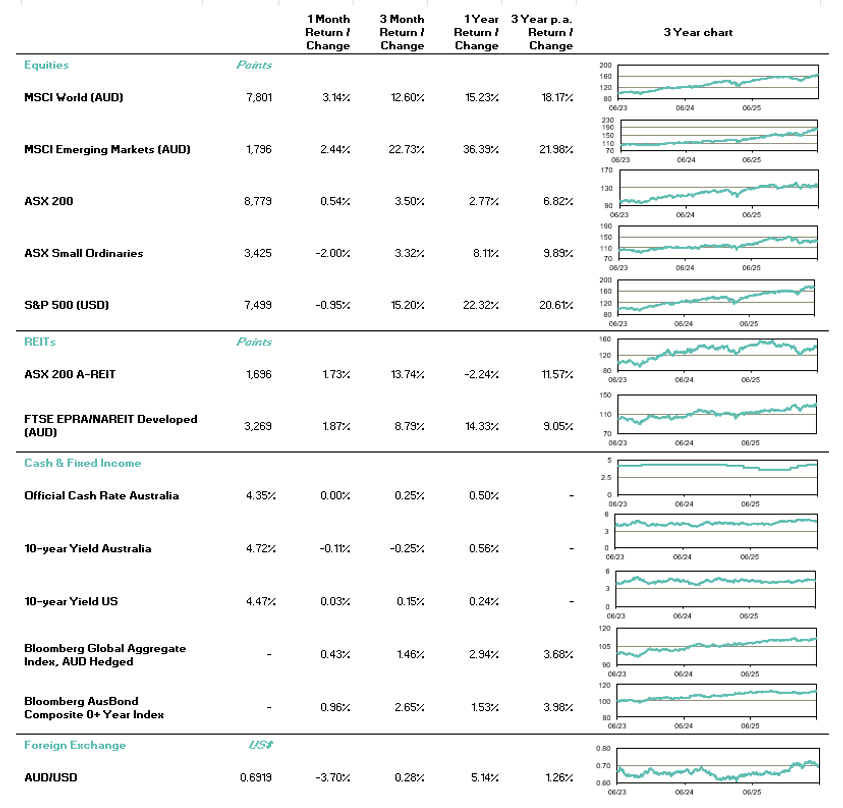
Australia: The RBA held rates at its June meeting, as widely expected, however the press conference skewed hawkish, as the Governor advised that a hold did not rule out future rate hikes. The market has priced 11.7bps of hikes by year-end.
- The ASX200 advanced +0.5% during June, with gains healthcare (+13.3%) and consumer staples (+13.0%) and discretionary (+12.2%) stocks outpacing losses from energy (-8.9%) and materials (-6.7%).
- The AUD depreciated -3.7% against the USD during the month, driven by USD strength.
- Employment increased by +40.3k in May, above consensus expectations for +32.5k, with all states except WA recording higher employment. The unemployment rate ticked lower to 4.4%, in line with expectations.
- Q1 GDP grew +2.5% YoY, slightly weaker than consensus +2.6% YoY. Household consumption was underpinned by essential goods, while discretionary spending growth was muted.
- May headline inflation fell sharper than expected, down -0.7% MoM vs consensus -0.4% MoM. Conversely, trimmed mean inflation increased +0.4% MoM, above expectations for +0.3% MoM. Domestic holiday travel and pharmaceutical products deflation drove the unexpected decline in headline inflation.
The Fair Work Commission announced a 4.75% increase to minimum award wages from 1 July, with some workers receiving up to a 6% increase.
New Zealand: Q1 GDP growth of +1.5% YoY was stronger than expectations for +1.0% YoY. This was driven by positive growth in labour-intensive services and goods-producing industries.
Europe: European equity markets broadly traded higher during the month, with the STOX600 and FTSE100 closing +2.4% and +0.3% higher respectively. The ECB delivered a 25bp hike as widely expected. The President of the ECB reiterated that inflation was too high, and was showing signs of broadening across sectors. The market has priced 23.6bps of hikes by year-end.
- The Bank of England kept rates on hold as expected. Market pricing suggests the BoE will deliver a 25bp rate hike by February 2027.
- European equities traded higher in June, with the STOXX600 up +2.5% on the month, while the FTSE100 advanced +0.8%.
- Eurozone unemployment ticked higher, with the May unemployment rate at 6.3%, slightly stronger than expectations for 6.2%.
- The Euro depreciated -2.0% against the USD during June, predominantly driven by strengthening in the USD.
- May preliminary CPI increased to +3.2% YoY, in line with expectations. Core CPI increase of +2.5% YoY was slightly stronger than consensus +2.4% YoY.
The Eurozone economic sentiment indicator (ESI) rose to 95.0 in June, stronger than expectations for 94.3 and the highest print since March.
China: Policy implementation is accelerating to stabilise investment. This includes the launch of the Three Gorges waterway project, significant AI buildout plans for data centers and a renewed urban renewal push.
- Manufacturing PMI returned to expansion in June, at 50.3, beating expectations for 50.1. Non-manufacturing PMI remained in expansionary territory, ticking higher to 50.2, above consensus 49.9.
- Industrial production rebounded to +4.5% YoY in May, slightly higher than expectations for +4.4% YoY.
- Retail sales contracted during May for the first time since COVID, down -0.6% YoY, softer than consensus -0.2% YoY.
- May headline CPI increased slightly more than expected, up +1.3% YoY vs consensus +1.2% YoY. Similarly, core CPI accelerated +1.2% YoY, stronger than the expected +1.1% YoY.
Australian dollar
- The Australian Dollar depreciated -3.7% against the USD over the course of June, driven predominantly by broad-based mechanical USD strength and developments in the Middle East conflict. The DXY index appreciated +2.3% on the month.
- The currency pair came under early pressure as the US Dollar strengthened following a robust non-farm payrolls report which outweighed the RBA's hawkish stance and weighing on the AUD.
- A brief period of USD retracement was observed mid-month, as diminishing safe-haven demand, underpinned by cautious optimism regarding a potential resolution to the Middle East conflict, exerted modest downward pressure on the currency.
- This was short-lived, with further USD strengthening observed after Warsh’s inaugural Fed meeting was more hawkish than expected. Alongside resilient economic data, this saw the USD move higher in the back half of the month.
- The AUD traded lower into month-end, facing selling pressure as the market priced increasing likelihood of rate hikes from the Fed in 2026. The AUDUSD closed the month at 0.6919.
Australian equities
- The ASX200 advanced +0.5% in June, notching a +2.8% return for the financial year. Healthcare and consumer stocks led the index in June, while energy and materials weighed on the index.
- Consumer stocks saw gains as an interim agreement was struck to end the Middle East conflict, oil prices receded and global inflation concerns cooled. The Consumer Staples and Discretionary sectors advanced +13.0% and +12.2% each. Discretionary retailers WES (+13.3%), NCK (+13.1%) and SUL (+12.4%) all saw strong gains.
- The Healthcare complex advanced +13.3% on the month, driven by gains in PME, up +53.8%. PME announced multiple contract wins in June, including a 5yr $28m contract renewal with Allegheny Health. Elsewhere in the sector, a number of stocks pared YTD losses, with CSL and COH gaining +18.8% and +21.1% each in June.
- Energy stocks fell -8.9%, with oil and gas stocks tracking an over 20% decline in oil prices throughout the month. WDS and STO fell -8.0% and -7.7% each, while BPT (-20.8%) and KAR (-25.6%) saw larger percentage losses.
- Materials fell -6.7%, with aluminium-exposed stocks tracking a 15.8% decline in the metal price during June. AAI -27.0%, S32 -18.9%. Mining majors BHP and RIO traded -4.7% and -7.1% lower respectively.
- Within the Financials (+1.8%) sector, JDO saw the largest percentage loss, down -39.7%. JDO saw declines after disclosing ~$70-80m of problematic loans from three exposures, and a resultant ~$20m increase in provisions.
- The tech sector gained +2.7% on the month, driven by gains in MP1 (+44.0%). MP1 advanced after announcing that it had secured four new contracts with a combined TCV of $458.9m and that it was creating an on-demand GPU Pool. To support this, MP1 raised $827.3m equity via an entitlement offer.
- Elsewhere in the sector, WTC (-8.4%) and XRO (-3.9%) saw declines alongside global peers in a broader software selloff.
Global equities
- Global equities were mixed in June, with tech-heavy Nasdaq (-2.7%) and S&P500 (-1.1%) seeing declines, while the Dow (+2.5%) and Europe’s STOX600 (+2.5%) advanced.
- Communication Services saw the largest percentage decline on the S&P500, down -7.9% on the month, while the tech sector fell -3.3%. The end of the month saw AI sentiment waver globally amid debt-funded tech spending and a surge in memory prices. This saw dispersion among tech names, with tech stocks seeing some of the top and bottom percentage moves on the index.
- Despite this, the STOXX600 tech sector gained +4.8%, driven by gains in semi equipment stocks. ASML +24.3%, ASMI +11.4%, STMicroelectronics +9.5%.
- Travel & Leisure stocks led the STOXX600, up +7.2%. Airlines Lufthansa (+16.7%), IAG (+11.0%) and Ryanair (+8.8%) saw some of the largest percentage gains.
- Energy stocks weighed on gains globally, as oil and gas stocks tracked declines in oil prices following optimism that passage through the Strait of Hormuz would recommence.
- The MSCI Asia Pacific Index fell -1.3% on the month, with Hong Kong (-9.1%) weighing on the region. The Kospi Index saw a volatile month, trading within a ~22% range before closing flat.
Property securities
- The global real estate sector returns turned positive again June, with the sector up +1.9% after a weaker May, as tensions in the Middle East lessened, resulting in lower oil prices and cooling inflation concerns.
- American REITs performed better than its global peers, up +4.3% in June, reversing -2% declines in May, furthered by falling fuel prices.
- The European region again underperformed US REITs, but was up +0.5% for the month, paring the -3% decline in May. Easing inflation concerns sparked the small rally, with buying resuming given cheaper valuations.
- APAC region returns were again weaker in June, with the region down ~4%, following a weaker May in which the sector was also down -4%. YTD, the APAC region is down -6%, significantly underperforming its global peers. Within the region, Japan and Australia outperformed, while HK/China underperformed.
- Locally, Australia was up +0.8% in June 2026, extending a +2.5% gain in May. This was driven by strong share price performance from LLC, INA and CHC, offset by weaker performance in DGT and DXS.
Fixed income and credit
- Apathy towards the US-Iran war set into markets in June, with oil prices falling and global rates rallying over the month despite oscillation between ceasefire talks and escalation throughout the month.
- However, US rates finished slightly cheaper on the back of fiscal premia concerns out of Japan and stronger than expected JOLTs print in the final 2 days of the month.
- Conversely, AU and NZ rates outperformed the US on the rally lower in June. AU outperformance was driven by markets beginning to price in the end of cycle. Q1 GDP began the month printing softer than expected at 0.3% vs 0.4% consensus, followed by falling consumer sentiment and an RBA hold that signalled inflation was too high but have space to remain data dependent going forward. May CPI (24th) and LFS (25th) revealed no smoking gun for a hawkish RBA, taking steam out of an August RBA hike and supporting the argument the RBA is near the end of the hiking cycle.
- In NZ, a lack of data in the first half of the month meant NZ rates traded in line with global peers, outperforming the US due to the weaker economic outlook facing the country. Q1 GDP (18th) grew 0.8% QoQ, in line with consensus, however the yearly number came in at 1.5%, beating 1.0% estimates and emboldening NZ hawks. Sentiment shifted in NZ regarding upcoming hikes following the signing of the Memorandum of Understanding between US and Iran, with expectations for a hike in July falling from 22bps priced to a low of 16.8bps as risks for higher inflation due to the conflict reduced.
- In the 2nd half of June both AU and NZ rates traded in a tight range, with no tier 1 data expected until July.
- Investment grade credit spreads were broadly unchanged on the month, while high yield credit spreads widened 5.6bps in June.
First Sentier Investors
Important information
This material is for general information purposes only. It does not constitute investment or financial advice and does not take into account any specific investment objectives, financial situation or needs. This is not an offer to provide asset management services, is not a recommendation or an offer or solicitation to buy, hold or sell any security or to execute any agreement for portfolio management or investment advisory services and this material has not been prepared in connection with any such offer. Before making any investment decision you should consider, with the assistance of a financial advisor, your individual investment needs, objectives and financial situation.
We have taken reasonable care to ensure that this material is accurate, current, and complete and fit for its intended purpose and audience as at the date of publication. No assurance is given or liability accepted regarding the accuracy, validity or completeness of this material and we do not undertake to update it in future if circumstances change.
To the extent this material contains any expression of opinion or forward-looking statements, such opinions and statements are based on assumptions, matters and sources believed to be true and reliable at the time of publication only. This material reflects the views of the individual writers only. Those views may change, may not prove to be valid and may not reflect the views of everyone at First Sentier Investors.
About First Sentier Investors
References to ‘we’, ‘us’ or ‘our’ are references to First Sentier Investors, a global asset management business which is ultimately owned by Mitsubishi UFJ Financial Group. Certain of our investment teams operate under the trading names AlbaCore Capital Group, FSSA Investment Managers, Stewart Investors, RQI Investors and Igneo Infrastructure Partners, all of which are part of the First Sentier Investors group. We communicate and conduct business through different legal entities in different locations. This material is communicated in:
- Australia and New Zealand by First Sentier Investors (Australia) IM Ltd, authorised and regulated in Australia by the Australian Securities and Investments Commission (AFSL 289017; ABN 89 114 194311).
- European Economic Area by First Sentier Investors (Ireland) Limited, authorised and regulated in Ireland by the Central Bank of Ireland (CBI reg no. C182306; reg office 70 Sir John Rogerson’s Quay, Dublin 2, Ireland; reg company no. 629188).
- Hong Kong by First Sentier Investors (Hong Kong) Limited and has not been reviewed by the Securities & Futures Commission in Hong Kong. First Sentier Investors, FSSA Investment Managers, Stewart Investors, RQI Investors and Igneo Infrastructure Partners are the business names of First Sentier Investors (Hong Kong) Limited.
- Singapore by First Sentier Investors (Singapore) (reg company no. 196900420D) and this advertisement or material has not been reviewed by the Monetary Authority of Singapore. First Sentier Investors (registration number 53236800B), FSSA Investment Managers (registration number 53314080C), Stewart Investors (registration number 53310114W), RQI Investors (registration number 53472532E) and Igneo Infrastructure Partners (registration number 53447928J) are the business divisions of First Sentier Investors (Singapore).
- United Kingdom by First Sentier Investors (UK) Funds Limited, authorised and regulated by the Financial Conduct Authority (reg. no. 2294743; reg office Finsbury Circus House, 15 Finsbury Circus, London EC2M 7EB).
- United States by First Sentier Investors (US) LLC, authorised and regulated by the Securities Exchange Commission (RIA 801-93167).
- other jurisdictions, where this document may lawfully be issued, by First Sentier Investors International IM Limited, authorised and regulated in the UK by the Financial Conduct Authority (FCA ref no. 122512; Registered office: 23 St. Andrew Square, Edinburgh, EH2 1BB; Company no. SC079063).
To the extent permitted by law, MUFG and its subsidiaries are not liable for any loss or damage as a result of reliance on any statement or information contained in this document. Neither MUFG nor any of its subsidiaries guarantee the performance of any investment products referred to in this document or the repayment of capital. Any investments referred to are not deposits or other liabilities of MUFG or its subsidiaries, and are subject to investment risk, including loss of income and capital invested
© First Sentier Investors Group
IMPORTANT INFORMATION
This document has been prepared by Count Limited (Count) ABN 11 126 990 832. While care has been taken in the preparation of this market update, no liability is accepted by Count, its related entities, agents and employees for any loss arising from reliance on this market update. Count advisers are authorised representatives of Count.




Connect with WSC Group