Book a Consultation
 LOGIN
LOGINThe latest Cotality Housing Chart Pack for July 2026 suggests the Australian property market is cooling rather than falling sharply, with conditions becoming more balanced after several years of strong growth.
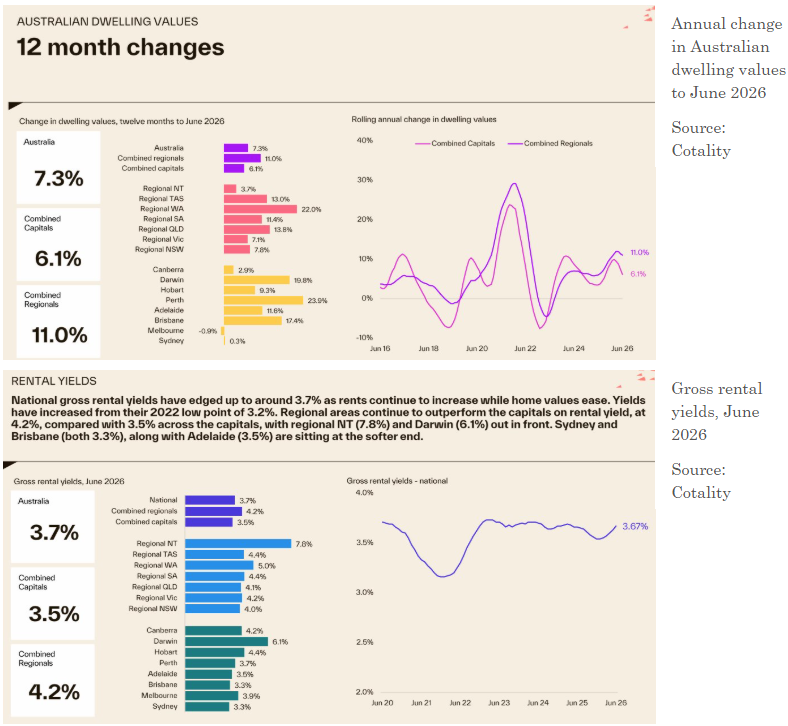
Australia's housing market remains resilient, but growth has slowed significantly in 2026. National home values fell 0.7% over the June quarter, the largest three-month decline since early 2023. Annual growth remains positive at 7.3%, although further moderation is expected.
Key trends include:
- Regional areas are outperforming capital cities, with regional property values rising 1.1% over the quarter while combined capital city values fell 1.3%.
- Sydney and Melbourne are the weakest major markets, with both recording price declines over recent months. Sydney values are now 3.7% below their January 2026 peak, while Melbourne remains below its 2022 high.
- Brisbane, Adelaide, Perth and Darwin continue to perform strongly, with values at or near record highs. Perth remains Australia's strongest major capital city market over the past year.
Buyers Have More Choice
Housing supply has improved noticeably during 2026.
- Total listings are up 8.4% from a year ago.
- Homes are taking longer to sell, with the national median selling time increasing to 32 days.
- Buyers are negotiating larger discounts, reflecting a more balanced market.
- Auction clearance rates have fallen from around 66% earlier in the year to the low 40% range, particularly in Sydney and Melbourne.
These trends suggest conditions are becoming less favourable for sellers and more favourable for buyers.
Rental Market Remains Tight
Despite softer property prices, rental markets remain under pressure.
- National rents increased 5.9% over the past year.
- Vacancy rates remain low across most markets.
- Rental yields have improved to around 3.7% nationally as rents continue rising while property prices stabilise.
This is positive news for investors seeking income, although affordability challenges remain for renters.
Interest Rates Continue to Influence Housing
Higher borrowing costs are having a clear impact on property demand.
- Mortgage rates remain above 6% for most borrowers.
- The Reserve Bank's cash rate remains at 4.35%.
- Cotality analysts believe any interest rate cuts are unlikely until well into 2027.
As a result, many households are being more cautious about taking on additional debt, helping to slow property price growth.
What This Means for Investors
For long-term investors, the property market appears to be transitioning from a period of rapid growth to a more sustainable pace. While short-term price growth may remain subdued, strong population growth, tight rental markets and ongoing housing shortages continue to support the long-term outlook for residential property.
Property prices are no longer rising as quickly as they were, buyers have more choice, rental income remains strong, and higher interest rates are helping to cool the market without causing widespread price declines.
Important information
This information has been prepared without taking into account your objectives, financial situation or needs. Because of this, you should, before acting on this information, consider its appropriateness, having regard to your objectives, financial situation or needs. You should obtain and consider the Product Disclosure Statement relating to any product referred to in this presentation before making any decision about whether to acquire the product.
WSC Group (Aust) Pty Ltd is an authorised representative of Count Financial Limited ABN 19 001 974 625, holder of Australian financial services licence number 227232 ("Count"). Count is owned by Count Limited ABN 11 126 990 832 of GPO Box 1453, Sydney NSW 2001. Count Limited is listed on the Australian Stock Exchange. The information on this web page is not financial product advice and is provided for information only.




Connect with WSC Group